
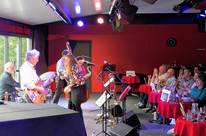
In Australia, as in many other Western countries, Father’s Day is celebrated on the first Sunday in September. This year it fell on 6 September. Knowing my long-standing love of jazz, my children decided to give me a present — they invited the whole family to a concert at the Brisbane Jazz Club.
For me, it was not simply a concert. It was a real journey along memory lane.
For those who do not know the history of this place, I will tell you a little about it. Originally, the club was called the “Adventurers Club”, and in 1970 it acquired its present name — the “Jazz Club”. In 1972, it moved to Kangaroo Point, into an old boatshed on the Brisbane River.
I remember the jazz concerts of those days. The venue was simply a wooden, weatherboard shed, but the music there was always wonderful. Directly opposite, across the river, was Brisbane’s central business district. As a result, the stage had a magnificent natural backdrop — the lights of the city at night over the river.
Today it is quite a respectable single-storey building, and the view has also changed somewhat too: the old outlines of the city have largely given way to skyscrapers. But the evening lights still provide a wonderful backdrop for the musicians.
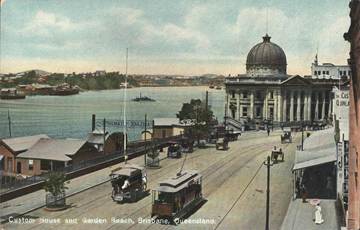
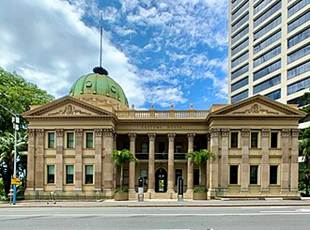
Directly opposite the Jazz Club, on the other side of the river, stands one of Brisbane’s architectural jewels — the old Customs House. And once again, a flood of memories came rushing back.
The Customs House was built in this particular place because ships of that period could come right into the centre of Brisbane, and the riverbank was then occupied by numerous wharves. Around them were many drinking and other establishments catering to sailors. They were still there in the 1950s. Later, during the transition period, these same pubs became places where city workers spent their leisure time.
Today, the wharves have disappeared. In their place are skyscrapers with apartments, fashionable restaurants, bars and clubs. And the new drinking establishments now cater to a completely different clientele — young, fashionable and prosperous people with fat wallets.
The Customs House itself, having lost its original purpose, passed into the ownership of the University of Queensland and is now regarded as one of Brisbane’s prestigious venues for restaurants, receptions and cultural events. Here, history and modern luxury are wonderfully combined, and the windows offer a magnificent view of the river.
Construction of the building was completed in 1889, and it served as the city’s principal customs collection point. Duties were collected here on goods arriving from overseas and from the other Australian colonies. I still remember the time when government employees sat within these walls, dealing with their endless paperwork. The offices where I myself worked were directly opposite the Customs House.
It is particularly interesting that the building has, as it were, two façades — one facing the street and the other, exactly the same, facing the Brisbane River. Today the building is squeezed between gigantic skyscrapers, but it still attracts attention. It reminds me of a beautiful child among a crowd of basketball players.
But this was far from the only memory that came back to me that evening.
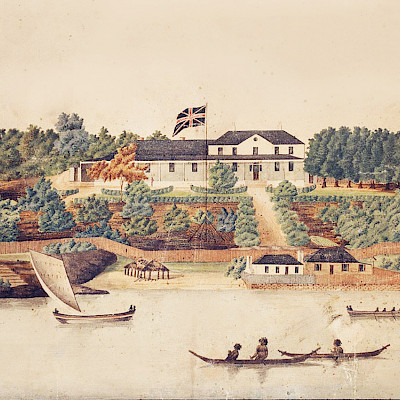
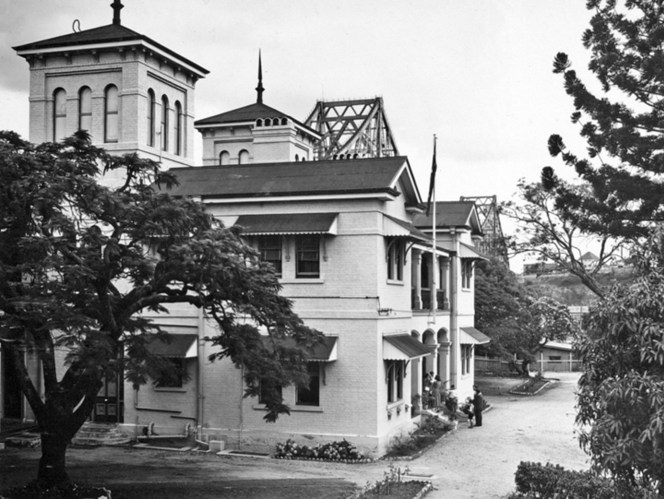
Just one block from the Jazz Club stands the historic building of Yungaba. The name “Yungaba” comes from the language of the Gubbi Gubbi Aboriginal people and means “place of sunshine”. If the walls of the Yungaba Immigration Centre could speak, they would tell many stories: of happiness, hope and the beginning of a new life, but also of sadness, suffering and loss.
Since its construction in 1887 on the banks of the Brisbane River, on Main Street in Kangaroo Point, Yungaba has served many different purposes. Originally built as an immigration reception centre, it received its first residents on 6 December 1887.
Although at different periods of its history the centre was used for many different purposes — as temporary accommodation for the destitute, a reception point for troops returning from the Boer War, a collection point for the repatriation of Pacific Islanders who were deported in the early twentieth century under the policy of “White Australia”, accommodation for workers building the Story Bridge in the 1930s, and even as a hospital for the treatment of venereal diseases during the Second World War — its purpose repeatedly returned to its original function - housing newly arrived immigrants. In 1978, Yungaba was still an immigration hostel. Newly arrived migrants lived there while studying English. It was in that year that this place acquired a completely special personal significance for me. So special that for several months I spent almost every evening there.
The reason was quite understandable — with extraordinary determination, I was storming the heart of a beautiful Cossack girl. Thanks to the advice of the great Russian commander Alexander Suvorov—"Speed and onslaught!"—the fortress was captured.
Almost fifty years later, I have been thoroughly pushed aside in this fortress by children and grandchildren, but still, I hope, there is still a small secluded corner left for me.
In 2008, the Queensland Government sold Yungaba to developers. The building was restored and converted into ten apartments. Three more residential buildings containing 140 apartments were constructed nearby, together with a multi-purpose cultural centre and a 224-seat auditorium.
Time goes on. Everything changes.
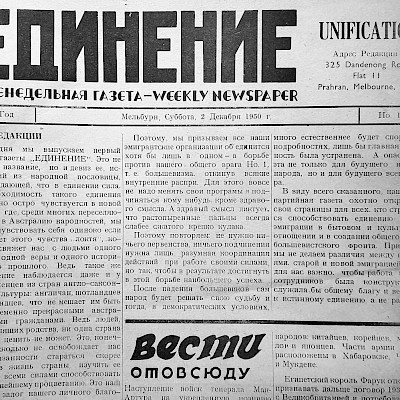
But in this area, many ghosts of the times past still wander. Among them are my own ghosts, as well as those of many Russian émigrés of the 1950s, 1960s and 1970s who had once lived or worked in this area. In those days, this was an industrial district. Evans Deakin Industries, a heavy engineering company, was located here, where ships were built and repaired and where there was a dry dock. Today, industry has completely disappeared. In its place are luxury apartments along the river, while the former dry dock has become a berth for yachts.
And so, quite unexpectedly, a family outing to a jazz concert became for me a journey almost half a century back in time.
As before, the music played, the lights of Brisbane were reflected in the river, and together with them people, places and an entire life returned from the depths of my memory.
All these memories came flooding back to me on Father’s Day — 6 September 2026.