

Among our “Postcards from the Past,” we sometimes come across ones that aren’t ours at all. Strange faces, unfamiliar signatures, other people’s roads. And sometimes — the opposite happens: among these random, forgotten, ownerless cards, small fragments of one’s own story suddenly resurface.
That’s what happened to me. In a “box” of old postcards, I unexpectedly found several that had belonged to my father. Mostly they were tiny scraps, barely noticeable traces of his path. Here is one of them — simple, unremarkable at first glance. But behind it lay more than just an image.
On it was the decision he once made long ago: to leave his home and cross into another country. A decision that changes a person’s fate. I will try to assemble a collage under the general title “The Fate of One Man.”
In a torn postcard, in a casual inscription, in a quiet memory — an entire life opens up.
THE CROSSING FROM DONO: A DOCUMENTARY ACCOUNT OF A 1927 BORDER ESCAPE
In March 1927, my father, Veniamine, left the village of Dono in the Trans Baikal region and crossed into Manchuria on foot. He was sixteen years old. He rarely spoke about the journey, and when he did, he described it in brief, factual terms. What follows is a reconstruction based on his recollections, the geography of the region, and the political conditions of the time.
My father belonged to a long clerical lineage. His father, grandfather, and earlier ancestors had all been priests. In the Soviet Union of the late 1920s, this background placed him in a category officially regarded as socially alien. The children of clergy were denied educational and professional opportunities, and he understood early that his prospects were limited. His uncle had retreated into Manchuria with the White forces several years earlier, and that connection provided him with a destination.
Dono was a small settlement northwest of the Manchurian frontier. The only major fixed landmark in the area was the Chinese Eastern Railway, which ran southeast toward the border. The straight line distance from Dono to Manchuria Station (now Manzhouli) was approximately 65–75 kilometres, but the practical route — following or keeping parallel to the railway — was closer to 80–90 kilometres. On foot, in winter, this required at least 24 to 36 hours of continuous movement. He would have had to walk through the night, through the following day, and into the next night if necessary. There was no possibility of long rest stops; the cold would not have allowed it.
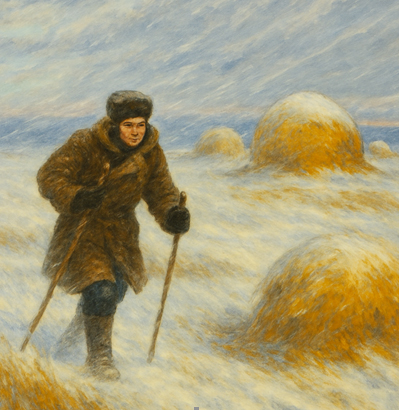
He chose to leave in the evening. He said it was simply safer that way. In daylight, OGPU border patrols were more active along the railway and near the border post at Otpor (now Zabaikalsk). At night, especially in bad weather, patrols tended to stay close to their huts. On the night he left, a blizzard was developing. Temperatures in that region in mid March could fall below −25 °C, and with wind gusts of 30–50 km/h the effective cold could reach −35 to −40 °C. In such conditions, even experienced riders avoided the open steppe.
He walked southeast until he reached the railway embankment or its telegraph poles. He never said how long that took, only that once he found the line he kept it in sight but did not walk directly on it. Patrols used the tracks as their main route, and he wanted to avoid them. Instead, he kept a parallel course, close enough to see the poles whenever the wind allowed, but far enough to remain unnoticed. In a blizzard, the poles were often the only vertical shapes visible.
At some point during the night, he lost them. He did not describe the moment in detail — only that the storm intensified and he could no longer tell where he was. He came upon a haystack, which was the only shelter available on the open steppe. Haystacks in that region were often placed near the railway or near small farm plots. He dug into the hay and stayed there for a while. Later he said he left too soon, thinking the storm had eased, but was forced to return almost immediately. The shelter was worse the second time; the opening he had made allowed the wind to enter.
Inside the haystack, he began to feel warm. He said he drifted into a dream in which his mother was making pancakes. It was a familiar memory, and for a moment he felt comfortable. Then, in the dream, he realized what the warmth meant. He was freezing. That realization, he said, was what made him force his limbs to move. At first they barely responded. Then, slowly, he regained enough control to crawl out of the haystack. The moment he stood up, the cold hit him again. He began to run.
Running in those conditions was difficult, but it generated heat. He eventually found the railway again — whether by sight, sound, or the feel of the ground he never specified. He followed it southeast. He passed the Soviet border post at Otpor, though he did not see it. In the blizzard, the border itself was invisible. He crossed into Manchuria without knowing the exact point at which it happened.
He reached Manchuria Station sometime after that. He did not describe his arrival in detail, only that he found warmth, people, and eventually his uncle. The entire journey had taken him through a night, a day, and part of another night, with only short, involuntary rests. The distance, the weather, and the lack of shelter made it an extreme undertaking, but he spoke of it plainly, without embellishment. The details he provided — the timing, the storm, the haystack, the disorientation — are consistent with the geography and climate of the region at that time.
My father never presented the story as an act of heroism. He regarded it as something he had to do, and he did it. But the facts of the journey — the distance, the temperatures, the blizzard, the lack of shelter, and his age — make it clear that it was a feat of endurance that only a few would have survived. His account, sparse as it was, aligns with what is known about the Trans Baikal frontier in the 1920s: a vast, exposed landscape where weather could be more decisive than any border guard.
He rarely returned to the story, and when he did, he told it in the same way: briefly, factually, and without comment on what it must have felt like. I have added nothing beyond what the landscape, the weather, and the historical record make unavoidable. The rest is his.
Con Drozdovskii, Brisbane